
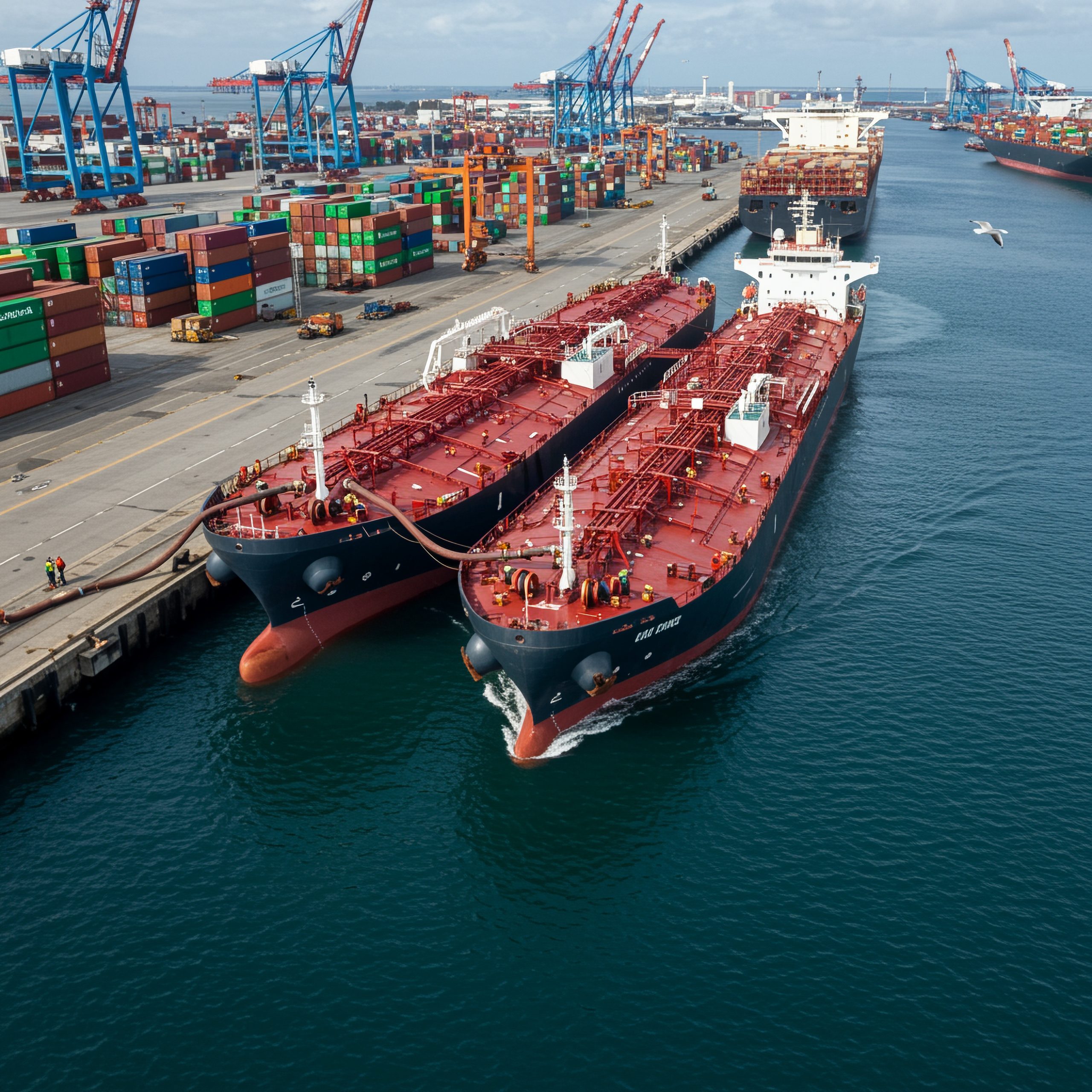
Ship-to-ship transfer lets cargo move between vessels without a port call, which removes draft limits, berth queues and canal transits from the equation. It also puts two moving vessels alongside each other with cargo under pressure between them. The safety record of STS is good precisely because the operation is heavily proceduralised, and the procedures start well before the two ships are in sight of each other.
The governing framework
STS operations sit inside a framework set by the International Maritime Organization and the industry guidance published by OCIMF, whose Ship-to-ship transfer Guide is the reference most charterers and terminals will expect an operation to follow. MARPOL Annex I also imposes requirements on oil transfers between vessels at sea, including the carriage of an approved STS operations plan and notification obligations.
The practical effect is that an STS transfer is not an informal arrangement between two masters. It is a documented operation with a named person in overall advisory control, an agreed plan, and a checklist regime that both vessels work through together.
Planning: location, weather and traffic
Location selection is the first decision and it constrains everything after it. The transfer area has to offer enough depth and sea room for two vessels to manoeuvre alongside each other, sit clear of traffic separation schemes and anchorages, and provide shelter appropriate to the season.
Weather limits are set during planning, not judged on the day. Wind, sea state and swell each have their own limiting values, and swell in particular is what usually stops an operation, because it drives relative motion between two hulls that are already in contact. A plan that only sets a wind limit is an incomplete plan.
Compatibility: the checks that prevent the expensive surprises
Two vessels are compatible when their physical arrangements and their cargo systems can be made to work together safely. The checks cover more ground than people expect:
- Size and freeboard. The parallel body length available for mooring, and the freeboard difference, determine how the fenders will sit and whether the manifolds can be connected without excessive hose strain.
- Manifold arrangement. Height above deck, spacing, reducer sizes and the presence of suitable blanks all have to be confirmed against the actual vessels, not against a class of vessel.
- Mooring equipment. Chocks, bitts and fairleads must be adequate for the loads expected, with the mooring pattern agreed in advance.
- Cargo systems. Pumping rates, maximum allowable working pressure, inert gas capability and emergency shutdown compatibility.
Fenders and hoses
Primary fenders keep the two hulls apart and absorb the energy of the approach and of relative motion once moored. Their size and quantity follow from the displacement of the vessels and the expected approach velocity, and their condition matters as much as their specification. A fender at the wrong pressure does not absorb the energy it was designed to absorb.
This is why pressure testing and inspection belong in the preparation phase rather than in the maintenance backlog. Rubber fatigue, valve leaks and damage to the chain and tyre net are all findable before an operation and all expensive to discover during one. The same applies to transfer hoses, which are pressure tested and inspected on a defined interval and rejected on condition, not on age alone.
Execution and the handover of control
During the approach and mooring, the person in overall advisory control coordinates between the two bridges. Both vessels work through the pre-transfer checklists together, connection is made and tested, and only then does cargo move. Throughout the transfer, pressure and tank levels are monitored continuously on both sides, with communication on an agreed primary and backup channel and an unambiguous emergency stop signal.
Disconnection is its own procedure: draining, blanking, and a controlled unmooring and departure that does not leave either vessel in an uncontrolled position relative to the other.
What good preparation buys
The value of a well-prepared STS operation is not just safety. It is predictability. The transfer happens in the weather window that was planned for, with equipment that was verified beforehand, between vessels whose arrangements were confirmed rather than assumed.
If you are planning an offshore transfer and want the compatibility study, fender package and superintendence arranged as one scope, speak to our operations desk.